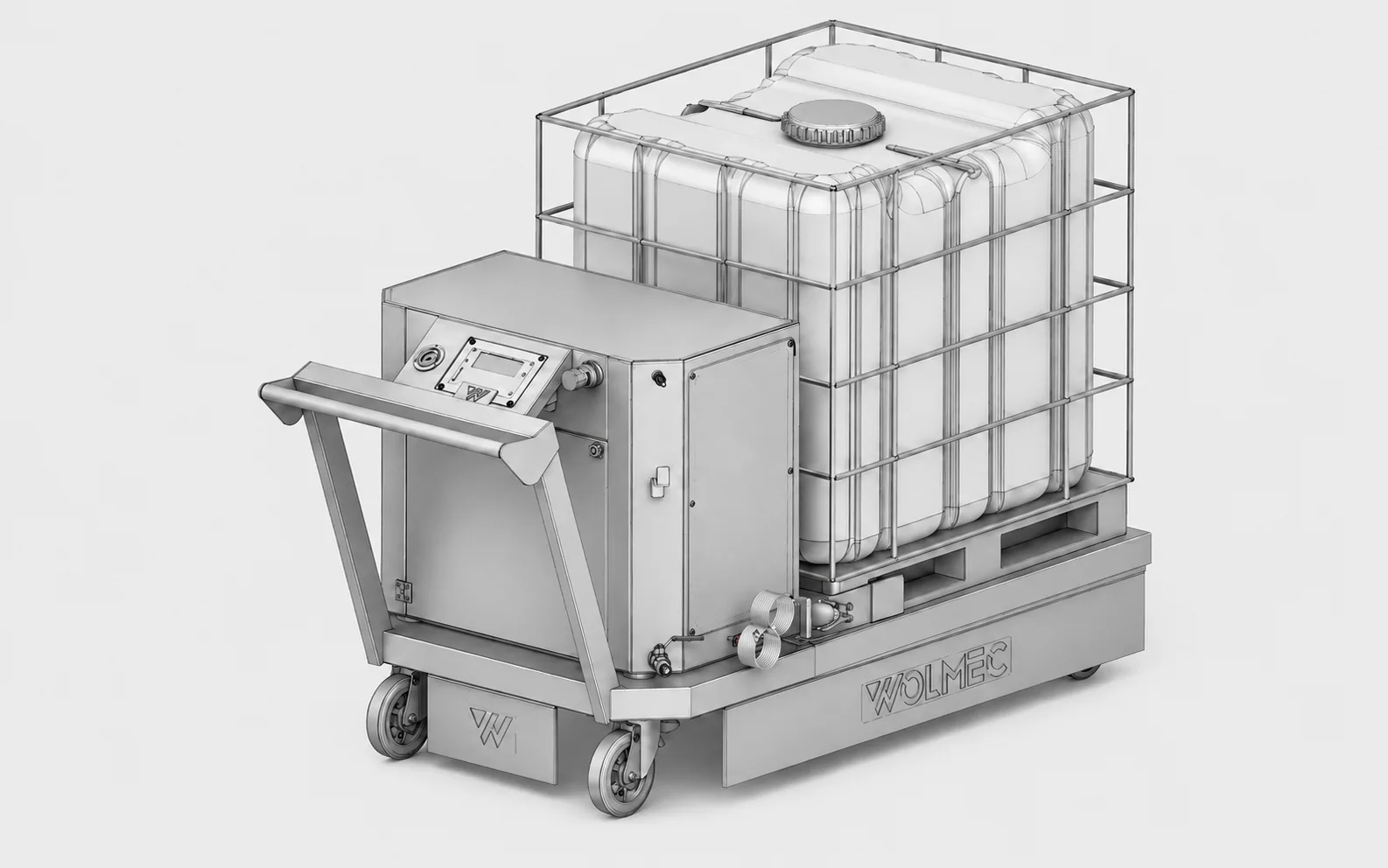
200 L DRUMS
DRUM RECEIVING
Product is withdrawn through a dedicated connection and transferred by a pump selected for its viscosity, chemical compatibility, target quantity and transfer time.

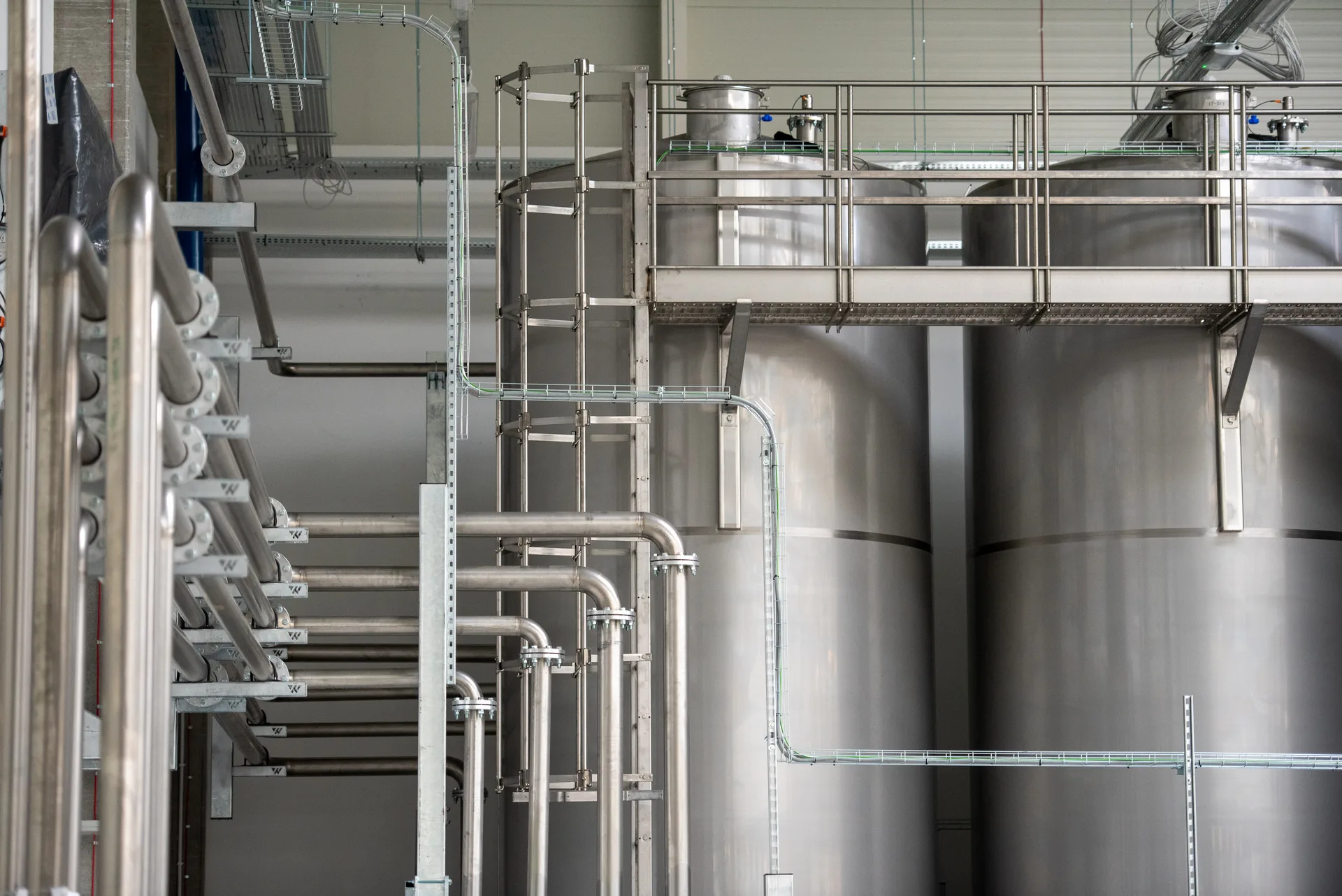
Custom turnkey plants
From liquid ingredients to the finished product
We design, build and commission complete liquid plants. Receiving, storage, conditioning, pumping, dosing and mixing — engineered around your liquid properties, recipes and production requirements.
From delivery to production
From unloading to the next production stage, every connection matters. We coordinate storage, temperature conditioning, pumping, dosing and mixing around the liquid and the way your plant operates.
Explore each stage and the automation that connects them.
Wolmec configures unloading and transfer for the actual supply format: 200 L drums, IBCs of any size or bulk tankers. The connection, pump, valves, flexible hose or fixed piping and control sequence are selected from product compatibility, viscosity, the available unloading method and the destination inside the plant.
200 L DRUMS
Product is withdrawn through a dedicated connection and transferred by a pump selected for its viscosity, chemical compatibility, target quantity and transfer time.
APPROX. 1 m³ IBCS
IBCs feed a mixer or process vessel directly, or supply a buffer, storage or dosing stage. Fixed and mobile configurations integrate the appropriate IBC outlet, hose, pump and safety controls.
PRESSURE OR PUMP TRANSFER
Unloading may use tanker pressure, the vehicle pump or a customer-side pumping unit. Wolmec defines the connection point, valves, piping, interlocks and route to storage or production.
Process, buffer and bulk tanks keep the right quantity of liquid available in the right condition. Working volume, compatibility, temperature and downstream demand shape the storage arrangement.

Tanks are sized to provide the working volume, surge capacity and process autonomy needed between receiving, dosing and mixing stages.
Bulk storage is arranged to match delivery volumes, consumption profile, refill strategy, product segregation and the available installation space.
Agitation and recirculation maintain uniformity, while heating, cooling and insulation keep the liquid within its specified operating range.
Tank geometry, construction materials, nozzles, instruments, load cells, access platforms and maintenance clearances are coordinated with the plant layout and site constraints.
Storage is not only a question of volume. Wolmec designs process, buffer and bulk tanks from chemical compatibility, usable capacity, viscosity, temperature profile, residence time, production demand and downstream duty. Depending on the liquid, the scope may include agitation, recirculation, heating, cooling, insulation, nitrogen blanketing, weighing, level measurement and access platforms.
Tank design begins with product data and operating duty. The key inputs are chemical compatibility, usable volume, batch frequency, viscosity, density, temperature limits, residence time, cleaning method and the connections to receiving and production.
Pumps, valves and piping are selected together around your liquid, the transfer route and the required delivery rate. Product compatibility, viscosity and operating conditions guide the complete arrangement.

A reliable transfer starts with the liquid and the real pipe route. Wolmec selects and sizes pumps, valves and piping from chemical compatibility, viscosity, density, temperature, solids content where applicable, suction conditions, quantity, target transfer time, distance, elevation difference and pressure drop. The complete system is coordinated to feed the next process stage at the desired rate while preserving product condition.
Pump principle and size are matched to the liquid and duty. Depending on the application, the solution may include progressive-cavity, gear or air-operated double-diaphragm pumps, or another technology dictated by the process.
Line diameter, wetted materials, seals, valves and connections are specified for the pressure loss, cleanability, drainability, operating temperature and liquid properties.
Transfer commands are interlocked with source level, destination availability, valve position, pump status and the production sequence to prevent incorrect routing and uncontrolled operation.
From a small addition to the main liquid ingredient, measurement and feed equipment work together to reach the recipe quantity. We coordinate pumps, valves and controls around accuracy and cycle time.

For automated liquid batching, Wolmec integrates gravimetric dosing with load cells, volumetric metering and mass flow metering together with pumps and controlled valves. The measurement principle is selected from dose size, liquid behavior, target accuracy, available cycle time and whether the ingredient is measured into a vessel or through a transfer line. Accuracy depends on the complete dosing architecture, not on the measuring instrument alone.
The system measures either the quantity added to a receiving vessel or the quantity removed from a weighed source vessel. Load cells, flow meters and the associated feed equipment are configured for the recipe and operating conditions.
Fast and fine feed stages, pump speed and valve cutoff are coordinated to reach the target without unnecessarily extending the batch cycle. Final compensation and control parameters are tuned to the real installation where necessary.
Each dose is linked to recipes, permissives, interlocks and alarms. Actual quantities, tolerance status and production data are available to the operator and exchanged with higher-level systems when requested.
We select or integrate the mixing technology around your product, batch size and required result. Ingredient additions, temperature and mixer operation follow one coordinated production sequence.

Wolmec identifies the mixing technology that best matches the product rheology, batch size, ingredient addition, temperature profile and finished-product target, then integrates it into the complete plant. When the customer has already selected a preferred mixer or process machine, Wolmec engineers the mechanical, electrical and automation interfaces needed to make it operate as part of the same production system.
Available solutions include agitators, dissolvers, dispersers and high-shear mixers. The technology may be selected by Wolmec or specified by the customer and integrated into the plant.
Liquid and solid additions, quantities, order, temperature steps, mixing speed and time are coordinated through recipe and interlock logic.
Process parameters are set to achieve the specified homogeneity, dispersion, dissolution or consistency before controlled discharge.
The finished batch moves to a buffer tank, filling line or the next production stage. Discharge, pumping and destination controls are coordinated to preserve product condition.

Once the batch meets its process conditions, Wolmec coordinates discharge to a buffer tank, filling line, downstream machine or existing production stage. The pumping method, pipe route, valve sequence and destination permissives are designed to preserve product condition and prevent incorrect transfers.
Vessel status, outlet valves, pump operation and destination availability are interlocked before transfer begins.
A buffer or holding tank decouples mixing from the next operation, maintains production continuity and accommodates different cycle times.
Pipework, connections, signals and control handshakes are defined with the receiving equipment, whether new, existing or supplied by another manufacturer.
One automation architecture coordinates receiving, storage, transfer, dosing, mixing and discharge. The control system manages recipes, sequences, permissives, interlocks and alarms, while giving operators a clear HMI view of plant status and production data.

Pumps, valves, tanks, mixers and instruments exchange status and commands so that each phase starts only when its process conditions are satisfied.
Recipes define target quantities, addition order, timing, temperature and mixing parameters. Operator permissions and manual functions are configured to match the plant's operating procedures.
HMI screens provide live status, alarms and batch information. Recipe commands and production data are exchanged with SCADA, MES or ERP systems when requested.
Liquid compatibility, cleaning, temperature and operating conditions guide the protective measures designed into each stage.
Construction materials, wetted parts, seals and surface requirements are selected from chemical compatibility, corrosion risk, operating temperature and the cleaning agents used on the plant.
The cleaning and changeover strategy considers product residues, cross-contamination risk, accessibility and drainability. Heating, cooling, insulation, agitation, recirculation, nitrogen blanketing and containment measures are integrated when the application requires them.
ATEX requirements are evaluated from product safety data, potential release points, area classification and operating conditions. Suitable equipment, electrical components, bonding, inerting and control measures are then defined through a project-specific risk assessment.
IBC ingredients brought into automated production. A compact Wolmec installation connects liquid supply, dosing, mixing and temperature monitoring under recipe control.

Automate resin production from ingredients supplied in IBCs, within a compact footprint and with liquids of different physical and chemical properties.
Pumping, controlled additions, mixing and temperature monitoring connected through customised recipe automation and an operator interface.
Liquid supply and recipe execution work together in one compact installation developed around the customer’s resin production process.
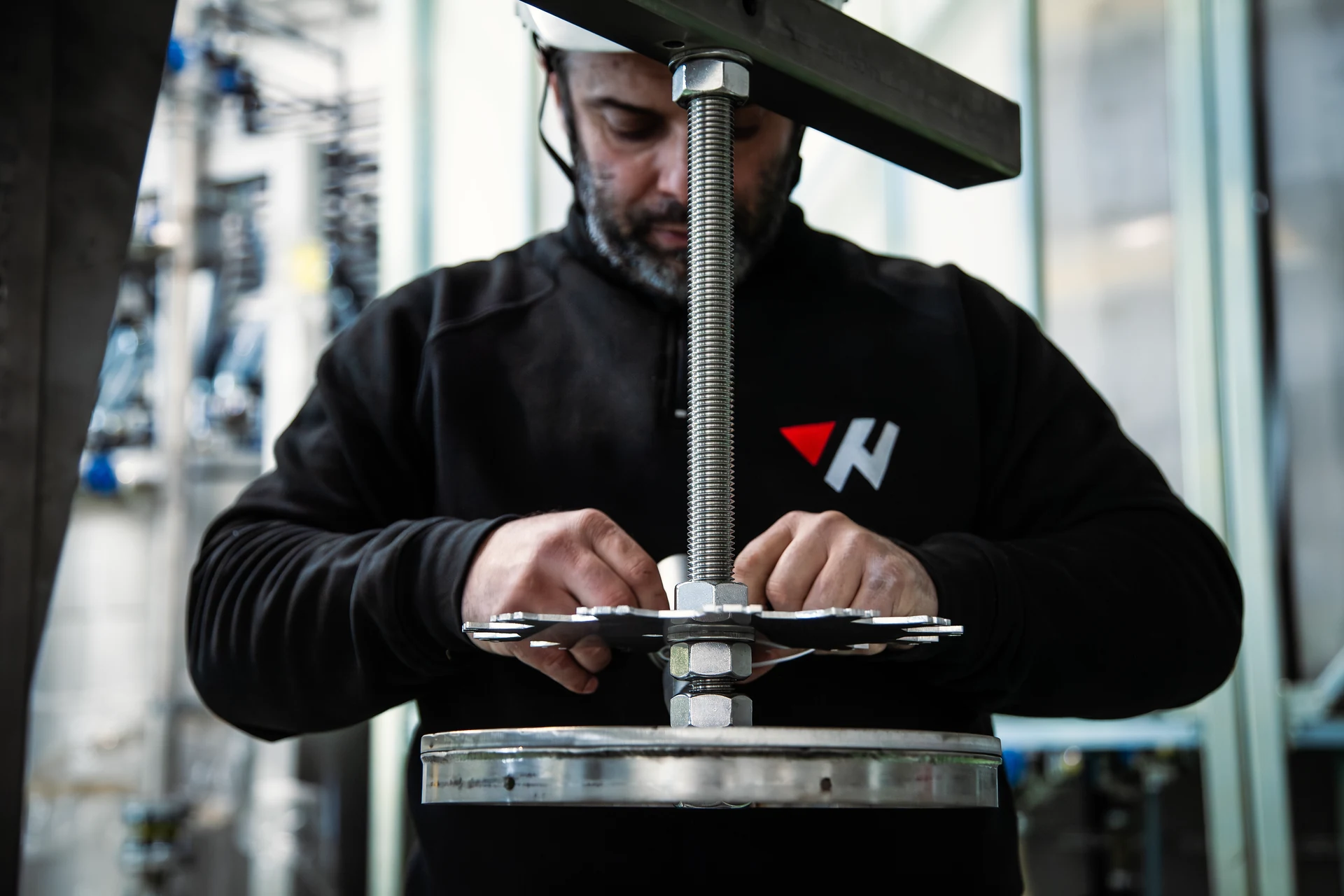
A partner for the life of your plant
Preventive and corrective maintenance for Wolmec-built and third-party liquid processing plants, available through six-month or annual service plans. Third-party equipment is first assessed to define its condition, critical points and the appropriate maintenance scope.
Explore Plant CareA defined starting point for a specific duty
Equipment and controls brought together for dosing from IBCs. Configured around your liquid and process connection, for stand-alone use or integration into a production line.
Practical questions
Every liquid plant is project-specific. These answers explain the technical inputs Wolmec uses to define the process architecture, equipment and controls.
An industrial liquid plant receives products from 200 L drums, IBCs or bulk tankers. Wolmec defines the unloading connection and transfer method from the liquid properties, delivery format, available utilities and destination in the process.
Pump selection begins with chemical compatibility, viscosity, density, temperature, solids content, suction conditions, quantity to transfer, pipe length, elevation and target transfer time. These inputs determine the pump principle, size, line diameter, valves and control method.
Storage tanks are specified from usable volume, delivery and consumption profile, residence time, product compatibility and temperature limits. Agitation, recirculation, heating, cooling, insulation, nitrogen blanketing, weighing and level instrumentation are incorporated where necessary.
Wolmec integrates weighing on load cells, volumetric measurement or mass flow metering. The system measures liquid added to a receiving vessel or removed from a weighed source vessel, with pumps, valves and control logic configured for the target quantity, accuracy and cycle time.
Yes. Wolmec integrates existing tanks, mixers and downstream machines, or new equipment selected by the customer. If the mixing technology has not yet been chosen, Wolmec identifies the most suitable solution and engineers its mechanical, electrical and automation interfaces within the complete plant.
Cleaning is established from product residues, cross-contamination risk, changeover frequency, drainability and access requirements. The resulting strategy may include manual provisions, flushing or an automated cleaning sequence, depending on the application.
ATEX measures are not selected from the liquid name alone. Wolmec evaluates product safety data, potential release points, area classification and operating conditions, then defines suitable equipment, controls and protective measures for the specific installation.
Start with your requirement
A new plant, more capacity or a process to improve. Tell us which liquids you handle and what your production needs to achieve.
You do not need a complete specification to start the conversation.